




PHP Releases Second Windows Security Update in Five Days to Address Brotli Code Execution Vulnerability
PHP has recompiled its official Windows packages for versions 8.2 to 8.5 to address CVE-2026-111497, a vulnerability in the Brotli compression library included in these packages. This vulnerability could allow an attacker to corrupt memory and potentially execute code. According to PHP, the vulnerability can be exploited via the cURL extension when it automatically decompresses…

Ex-Pentester Utilized ARTEX AI to Acquire 8.2 Million Data Records
Authorities in South Korea have identified seven individuals connected to a cybercrime scheme that infiltrated over 90 organizations within the nation, with the ARTEX AI pentesting framework being employed in the majority of the attacks. As reported by local media referencing the Seoul Metropolitan Police, the leader of the group has experience in penetration testing…
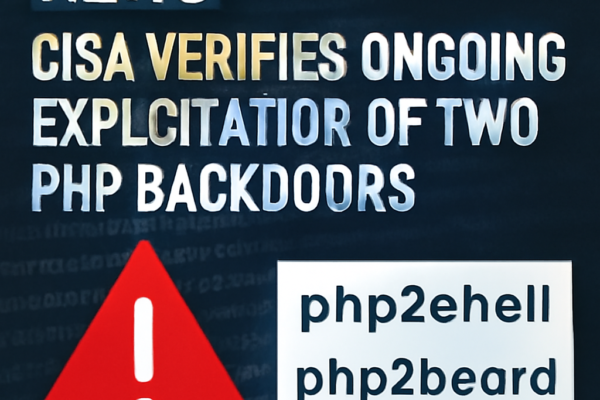
CISA Verifies Ongoing Exploitation of Two PHP2Shell Vulnerabilities Allowing Remote Code Execution
On Monday, the U.S. Cybersecurity and Infrastructure Security Agency (CISA) confirmed that the recently patched PHP2Shell vulnerabilities are being actively exploited, adding them to its Known Exploited Vulnerabilities (KEV) catalog. Both PHP vulnerabilities, which have a CVSS score of 9.2, enable unauthenticated remote code execution on affected systems: CVE-2026-109618 – A vulnerability related to out-of-memory…

Hackers Take Advantage of Plex2Shell Vulnerabilities to Install Crypto Miners and Linux Proxy Backdoor
Malicious actors have started to take advantage of a series of vulnerabilities in Plex Media Server to install cryptocurrency miners and reverse proxy software, just one day after a proof-of-concept (PoC) was released to the public. A researcher known online as boredhackerblog reported that the exploitation involves a combination of four distinct vulnerabilities, collectively referred…

Hackers Take Control of AOMEI Update Servers to Covertly Distribute Malware
It has been reported that hackers gained access to AOMEI’s servers to disseminate malware via a built-in promotional feature within its backup software. They briefly altered configuration files before reverting them to their original state to conceal the attacks. The supply chain attacks occurred between April and July 2026, targeting the update and notification systems…

Hackers Utilize New ROMULUS ClickFix Platform to Distribute LegionLoader and Other Malware
Cybersecurity experts have revealed information about a ClickFix delivery system named ROMULUS that is being utilized to spread malware, including Legion Loader. As reported by Forescout Research – Vedere Labs, ROMULUS functions similarly to a malware distribution service, using ClickFix-style bait on fraudulent landing pages to deceive unsuspecting individuals into executing harmful commands that compromise…

tenfold CE: Our complimentary Identity Governance tool has received 2 new features
tenfold’s Community Edition provides organizations with fewer than 150 users complete access to our Identity Governance and Administration (IGA) solution. Recent enhancements have introduced additional free features for CE users, including access reviews for shared content and centralized event auditing. As IT environments grow increasingly fragmented and intricate, ensuring that your workforce has access to…

⚡ Weekly Recap: NetScaler and FortiMail 0-Days, AI Coding Leaks, Spectre v2 and Ransomware Arrests
A vacant field. An open repository. A single response to an email. An unprotected box. None of these scenarios seem particularly alarming, which is part of the issue. This week’s threats continue to exploit minor details that are often easily missed. There are vulnerabilities currently being exploited, more streamlined intrusion methods, advanced automation, and a…

Microsoft Exchange Vulnerability Allows Authenticated Users to Access Other Users’ Mailboxes
Microsoft has issued out-of-band security updates to fix a critical vulnerability in Microsoft Exchange Server that may enable an attacker to escalate their privileges under specific circumstances. This vulnerability, identified as CVE-2026-96940, has a CVSS score of 8.8. According to an advisory published on October 2, 2026, Microsoft stated, “Weak authorization in Microsoft Exchange Server…

Bitget Reports $388M Theft Linked to Third-Party Security Flaw
According to Bitget, the cryptocurrency exchange, the individual responsible for the theft of approximately $388 million accessed the platform via a vulnerability in a third-party security product utilized by the exchange, as stated on Monday. The attacker took advantage of this flaw to acquire high-level internal credentials, which were then used on September 24 to…